These two get compared constantly, and the comparison is more interesting than it looks - because they are not really rivals. They are separated by about fifteen years, one of them is a landrace that grew out of northeast India over centuries, and the other was deliberately engineered in South Carolina to break a record.
One is a place. The other is a project.
The heat gap is bigger than it sounds

C. chinense
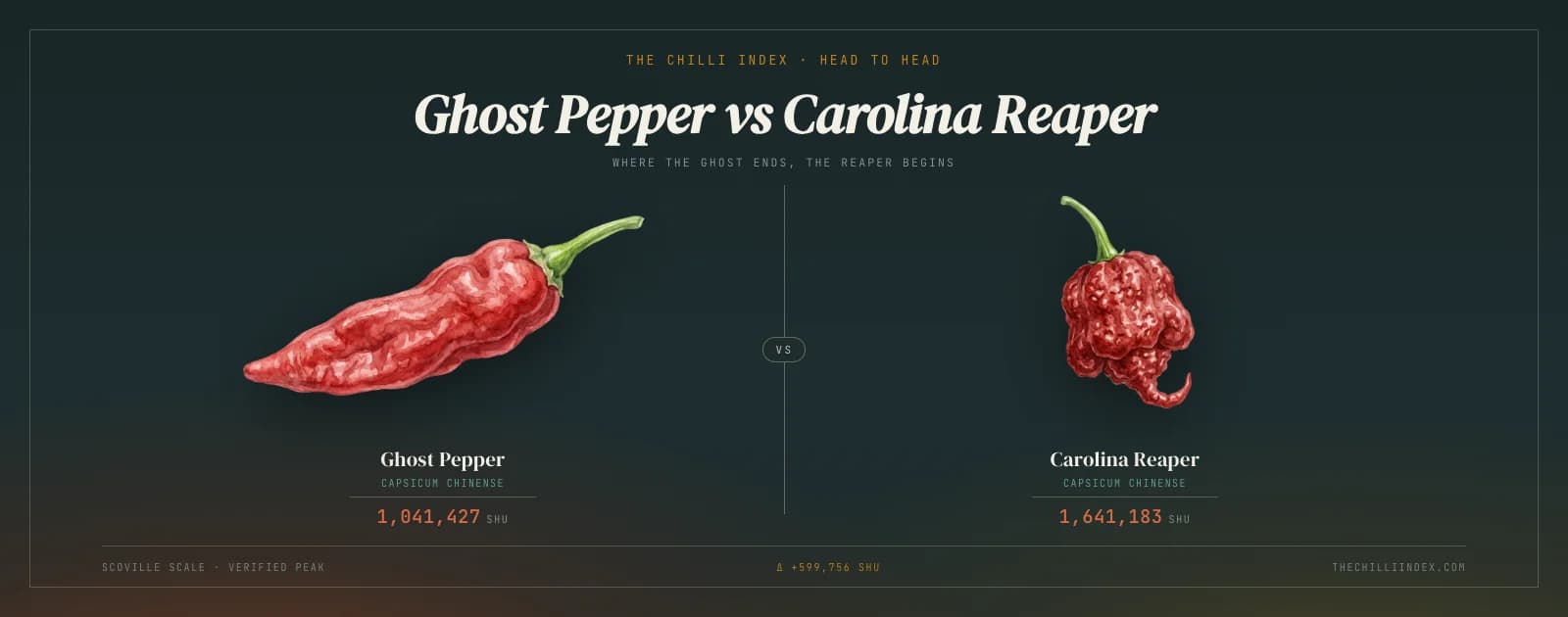
Ghost Pepper
1,041,427 SHU
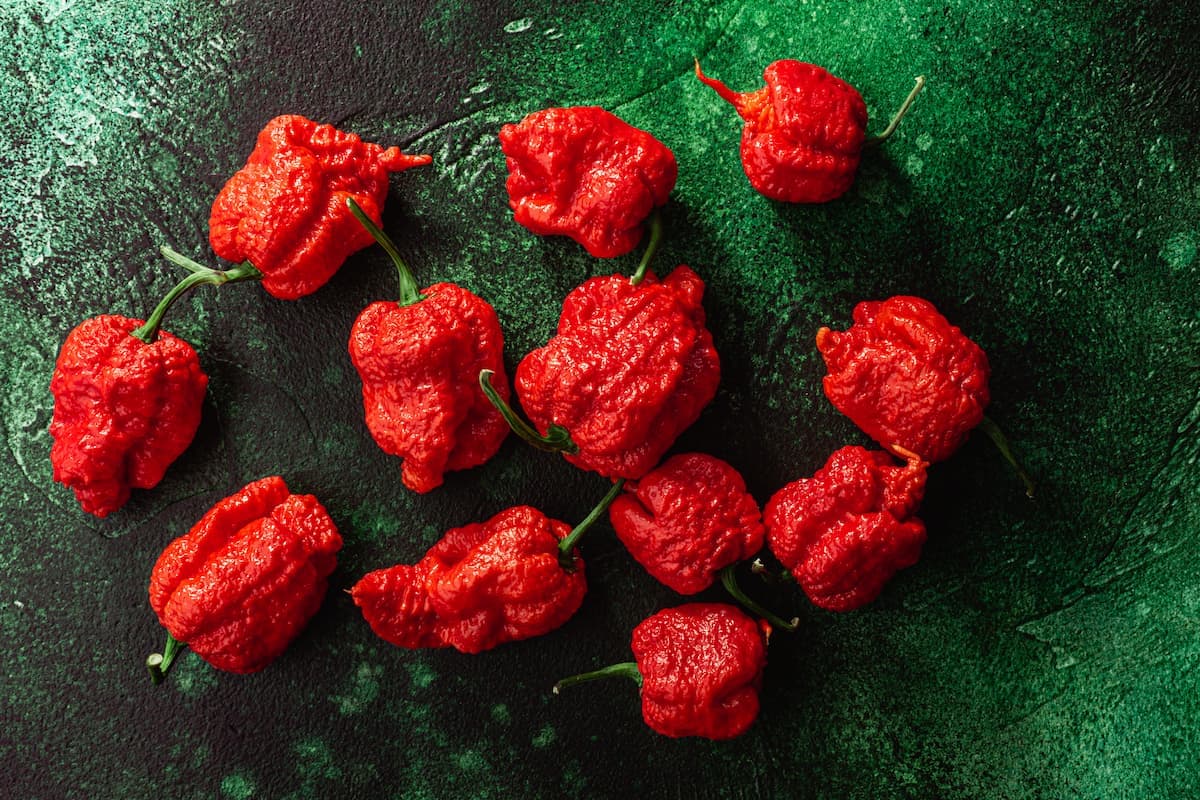
C. chinense
Carolina Reaper
2,200,000 SHU
The ghost pepper - Bhut Jolokia - was certified by Guinness in 2007 at 1,041,427 SHU, the first chilli ever verified above a million. The Carolina Reaper took the title in 2013 at an average of 1,641,183 SHU.
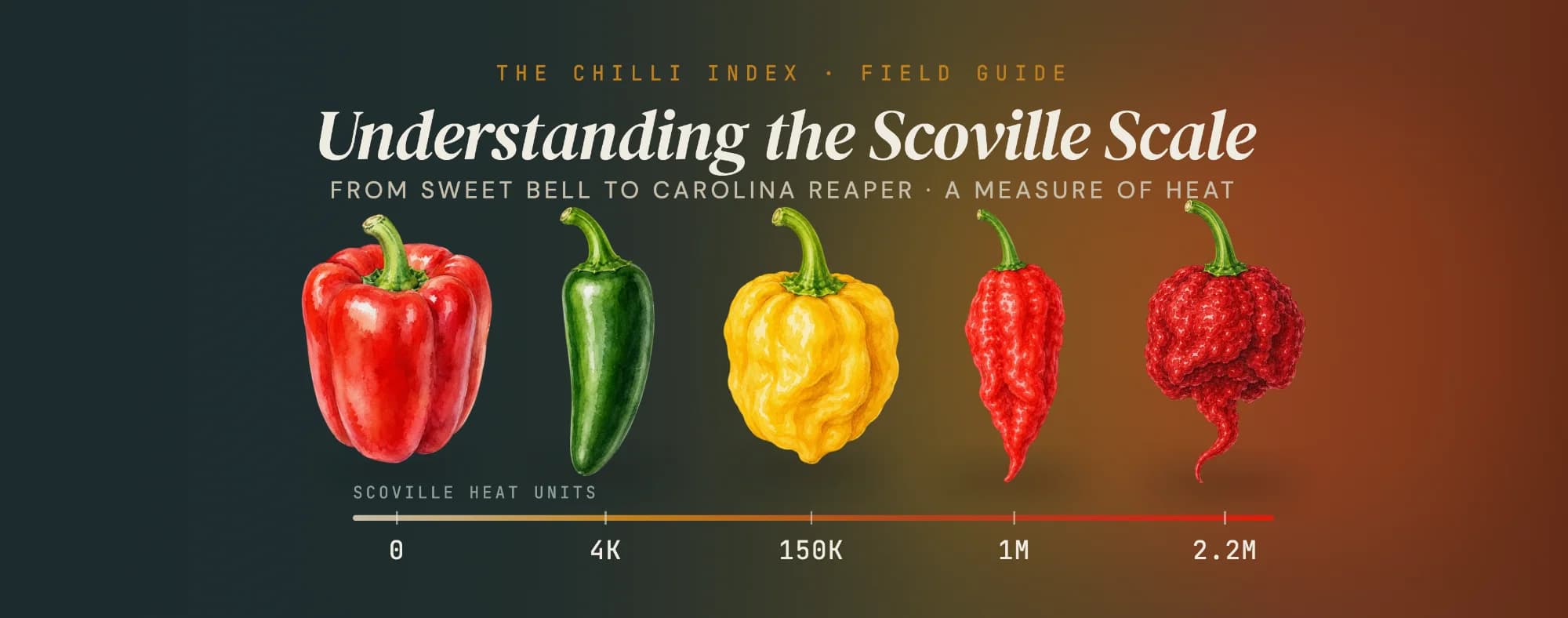
That is roughly 60% hotter on paper. In the mouth the difference is smaller than the arithmetic implies, because capsaicin response saturates: past about a million SHU you are no longer really registering more heat so much as heat that arrives faster and stays longer.
Scoville
1,041,427 SHU
Scoville
2,200,000 SHU
What people actually report is a difference in shape rather than magnitude. The ghost pepper builds slowly - a genuinely deceptive thirty seconds where you might conclude it is manageable - and then plateaus for a long time. The Reaper arrives faster, peaks harder, and has a sharper edge to it.
Where they came from
The ghost pepper is from Assam, Nagaland and Manipur in northeast India, where it has been grown for generations. Bhut jolokia is the Assamese name; the "ghost" in English is a rendering of bhut, though the etymology is disputed and may refer to Bhutan rather than to ghosts.
It is not a bred variety in the modern sense. It is a landrace - a regional population that farmers shaped by saving seed, with real variation within it. It is used locally in curries and chutneys and, notoriously, as an elephant deterrent on fence lines.
The Carolina Reaper is the opposite in every respect. Ed Currie crossed a Pakistani Naga with a Red Habanero in South Carolina with the explicit intention of producing the hottest chilli in the world, and then submitted it for certification. It has a breeder, a birth date, and a company behind it.
That difference explains most of what follows.
Flavour, which is where it actually matters
If you are choosing between them to cook with, ignore the Scoville numbers and read this section instead.
The ghost pepper is smoky and slightly earthy, with a sweetness underneath that survives cooking. It is the more versatile of the two in a savoury dish. Dried and ground it makes an excellent chilli powder, and it holds its character in slow-cooked curries where the heat has time to distribute.
The Carolina Reaper is fruitier and brighter - a distinct cherry or stone-fruit note in the first second - but with far less time to appreciate it before the heat closes in. It suits applications where a very small quantity is doing a specific job: hot sauces, infused oils, anything where you want ferocity plus a fruit note.
Growing them in Britain
Both are Capsicum chinense, so both want the same things: an early sowing, bottom heat to germinate, and a long warm season under cover.
The ghost pepper is meaningfully easier.
It germinates more readily, grows faster, and - critically for a British season - ripens earlier. Its landrace background means more genetic variation and a little more resilience. It is a realistic greenhouse crop across most of England from a February sowing.
The Reaper needs a January sowing, near-guaranteed bottom heat at 28°C, and a greenhouse or conservatory to finish. It is slower at every stage.
The British alternative worth knowing about is the Dorset Naga, which sits between them for heat and was selected specifically to crop in this climate.
C. chinense
Dorset Naga
1,600,000 SHU
Substituting between them
Going Reaper to ghost: use roughly one and a half times as much and expect a slower, smokier, less sharp result. Usually an improvement in a cooked dish.
Going ghost to Reaper: use around two thirds and be careful. The heat arrives faster than the recipe assumes, and there is less warning.
Neither substitution is a problem in a sauce or a long-cooked dish. Both are risky in anything served raw, where the pepper's own character is exposed.
So which one?
For cooking: the ghost pepper, comfortably. More usable range, better savoury character, easier to dose.
For growing in Britain: the ghost pepper again, or the Dorset Naga if you want the challenge with a British-bred plant that expects our summers.
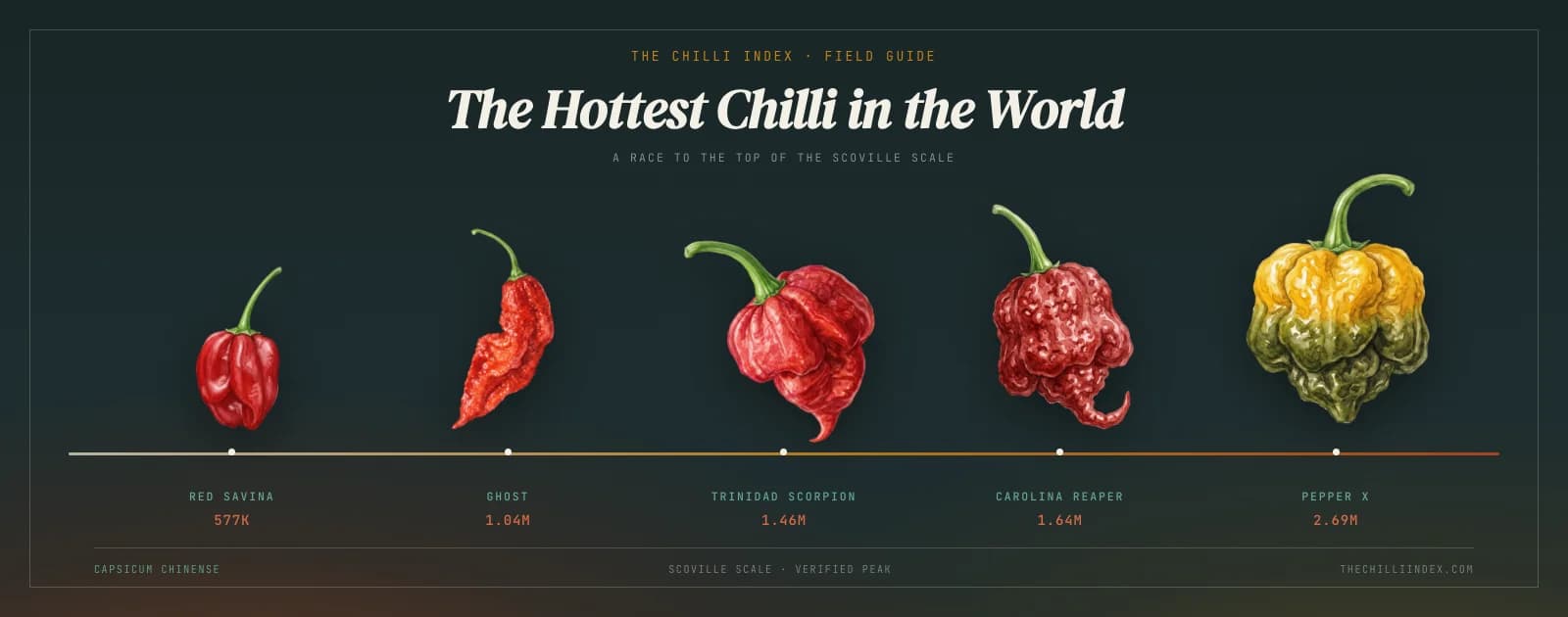
For the achievement: the Carolina Reaper. It held the world record for a decade, it is the one everyone has heard of, and getting one to ripen in a British October is a genuine result. The Reaper held the world title from 2013 until 2023, when Ed Currie's own Pepper X (around 2.69 million SHU) took the crown.
The heat difference between them is real but overstated. The difference in what they are for is the one that should decide it.