Bite into a hot chilli and your body does something odd: it reacts as though you've actually been burned. Watering eyes, a racing heart, the urge to reach for something - anything - to make it stop. No tissue is being damaged, but the alarm is entirely real. The Scoville scale is our attempt to put a number on that alarm, and it's a more interesting number than it first appears.
Most people have seen the scale - the ladder that runs from a harmless bell pepper up to something with a name like a heavy-metal band. Fewer know what the numbers actually mean, why they're so often given as a range, or why a pharmacist with no interest in cooking invented the whole thing over a century ago. Here's the full picture.
The man who measured heat
The scale is named after Wilbur Scoville, an American pharmacist who, in 1912, was working for the drug company Parke-Davis. His problem was a practical one: capsaicin - the compound that makes chillies hot - was used in muscle rubs, and he needed a reliable way to measure how much "kick" a given batch of peppers carried. Too little and the product did nothing; too much and it was unusable.
His solution was the Scoville Organoleptic Test. He dried a measured amount of chilli, dissolved it in alcohol to extract the capsaicin, then diluted that extract in sugar water. A panel of trained tasters sipped progressively weaker dilutions until a majority could no longer detect any heat. The amount of dilution needed became the score. A chilli that had to be diluted five thousand times before the burn disappeared earned 5,000 Scoville Heat Units.
It was clever, cheap, and - by modern standards - wildly imprecise. But it gave the world its first common language for heat, and the unit has stuck for over a hundred years.
What a Scoville Heat Unit actually is
A Scoville Heat Unit (SHU) is, at heart, a dilution factor. It answers a single question: how much do you have to water this chilli down before a person can't taste the heat any more? The higher the number, the more capsaicin there is to dilute.
That framing exposes the original method's weakness straight away - it depended entirely on human tongues. Palates fatigue. Tolerance varies enormously from one taster to the next. Give the same pepper to five people and you'll get five slightly different answers. This is a large part of why heat figures have always come as ranges rather than single, tidy numbers, a point worth holding onto for later.
1912 · Organoleptic
The taste-dilution test
Human tasters sipped ever-weaker dilutions until the burn vanished. Cheap, clever — and, by modern standards, wildly imprecise.
Today · HPLC
Measured directly
A lab separates the extract and measures capsaicinoids directly, in parts per million — then converts to SHU. Objective and repeatable.
Why chillies burn in the first place
To understand the scale, it helps to understand the burn. The heat of a chilli comes from a family of compounds called capsaicinoids, the most important being capsaicin itself. Capsaicin has no smell and no flavour of its own. What it does have is a very specific talent: it binds to a receptor in your body called TRPV1.
TRPV1 is a sensor that normally fires when it detects genuine heat - temperatures above roughly 43°C - or physical abrasion. It's part of how you know to pull your hand off a hot pan. Capsaicin fits this receptor like a key in a lock and switches it on regardless of the actual temperature. Your nerves dutifully send the message they're built to send: this is hot, this is damage, do something. Your brain believes them. The result is a burning sensation with no burn behind it.
Capsaicin fits the same receptor that detects real heat and switches it on regardless of temperature — so your nerves report a burn that isn't happening.
The body's response - sweating, flushing, a flood of endorphins as it tries to dampen the perceived pain - is also why chilli-eating can be genuinely pleasurable rather than simply unpleasant. You're getting a real physiological reward for a threat that never actually arrives.
Capsaicin has no taste or smell of its own — its whole effect comes from the vanillyl head slotting into the TRPV1 receptor.
How heat is measured today
Modern laboratories don't rely on tongues any more. The standard method is High-Performance Liquid Chromatography, or HPLC, which separates a chilli extract into its component compounds and measures the concentration of capsaicinoids directly, in parts per million. That figure is then converted into Scoville Heat Units so it can sit alongside the century of numbers that came before it.
HPLC is objective and repeatable in a way a taste panel never could be. It's also the reason record attempts carry real weight: to be recognised as the world's hottest, a pepper must be tested by an accredited laboratory, with multiple pods sampled and the results averaged. The days of a grower simply declaring a new champion are long gone.
One quiet caveat: a lab measures capsaicinoid content, not perceived heat. The two usually track together, but how hot a chilli feels also depends on which capsaicinoids are present and how quickly they hit - which is why two peppers with similar SHU can deliver very different experiences.
Reading the scale
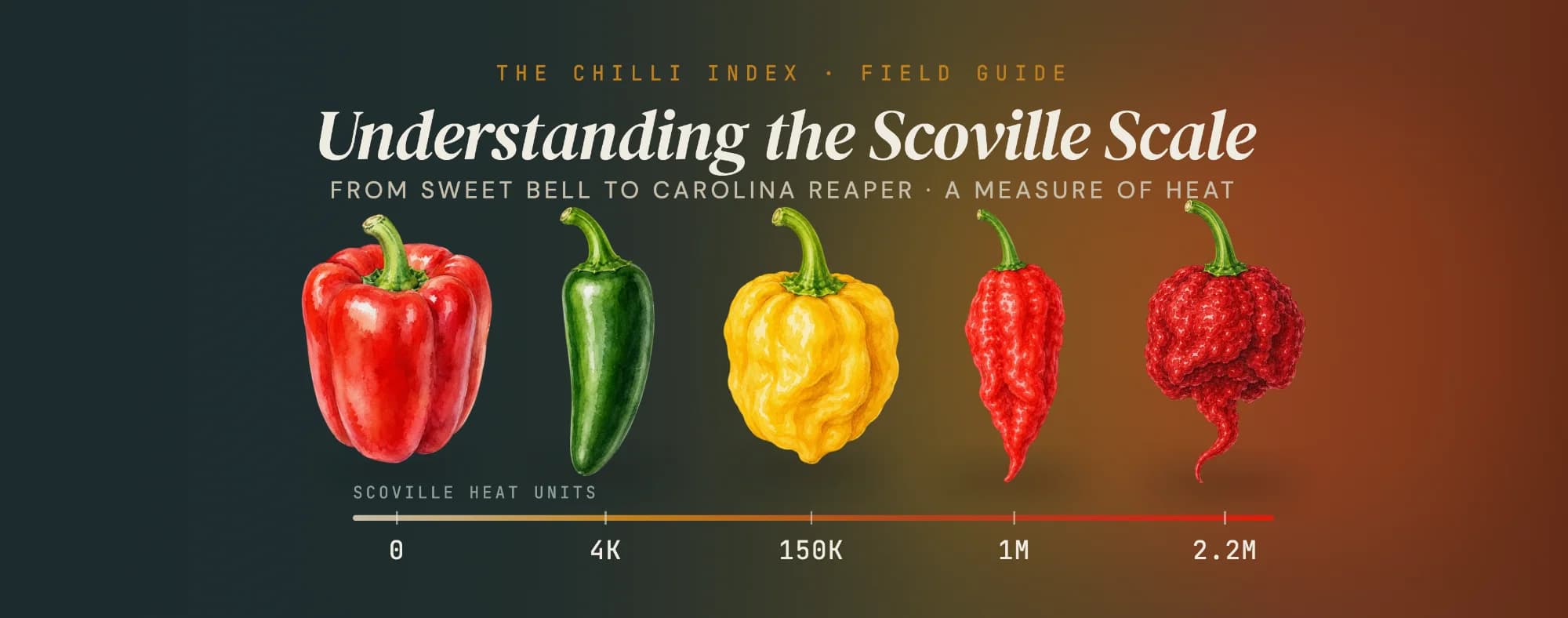
Here's the scale itself. The first thing to notice is that it can't be drawn honestly on a straight line: a bell pepper scores zero, a jalapeño a few thousand, and Pepper X close to three million. Plot that evenly and everything below "superhot" collapses into an invisible smear at the bottom. So the ladder below is logarithmic - each step up represents a multiplying of heat, not a simple addition. It's the only way to see a jalapeño and a Carolina Reaper on the same chart.
Each step up is a multiplying of heat, not an addition. Hover, tap or focus a dot.
Working up from the bottom:
- No real heat (0-1,000 SHU): bell peppers, most padróns. Flavour without fire.
- Everyday heat (1,000-10,000): jalapeños and serranos - the workhorses of a spice-tolerant kitchen.
- Properly hot (10,000-100,000): cayenne, bird's eye. Enough to command respect and dominate a dish.
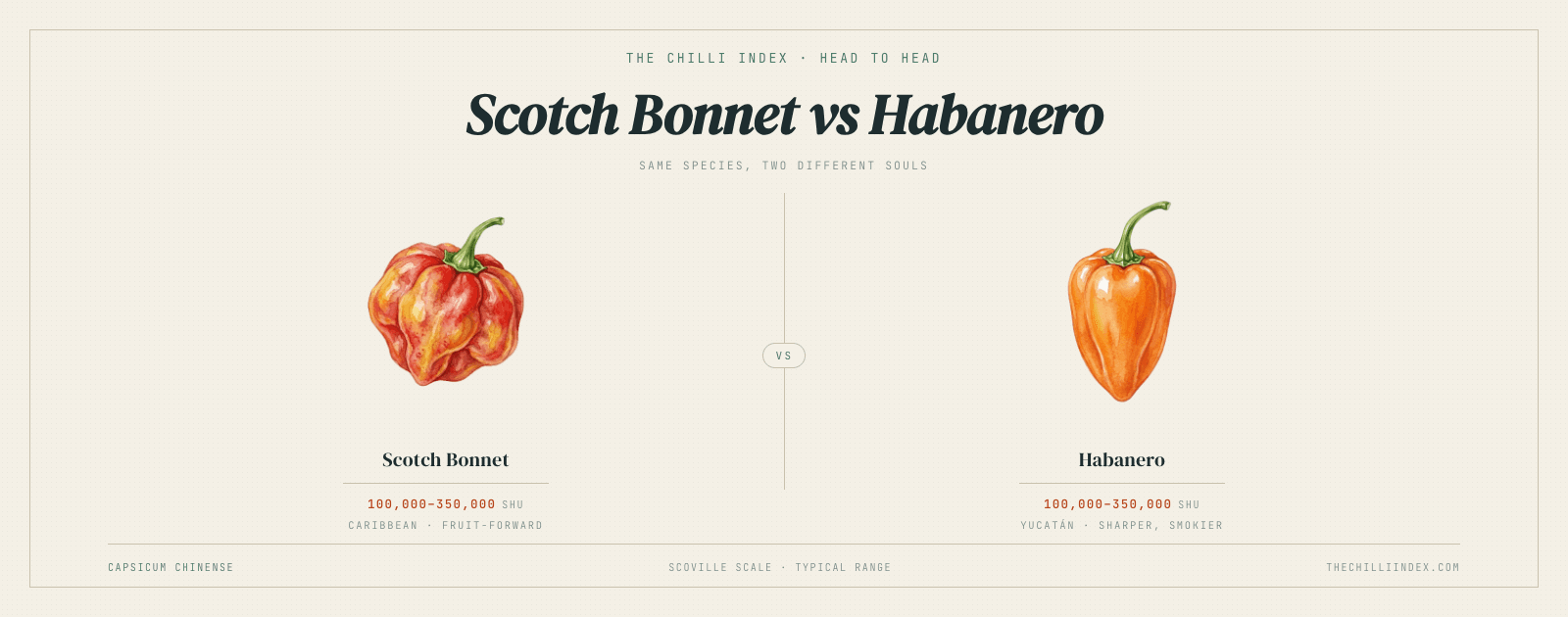
- Very hot (100,000-350,000): the Scotch bonnet and habanero tier - fruity, fierce, and the point at which casual eaters bow out.
- Superhot (350,000-1,000,000+): ghost peppers and beyond, where heat stops being a seasoning and becomes an event.
- Record-breakers (1,600,000+): the Carolina Reaper, and now Pepper X. Bred for one purpose, with little culinary use beyond bragging rights.
One clarification, because the word gets used loosely. This index draws the superhot line at 100,000 SHU, so a habanero carries the same badge on its variety page as a Carolina Reaper does. The rungs above are descriptive rather than official - there is no governing body for any of this, and where one tier ends and the next begins is a matter of custom.
Why heat is a range, not a number
You'll notice the Index almost never gives a single SHU figure for a variety, and neither does any honest source. That's not vagueness - it's accuracy.
Genetics set a chilli's ceiling: a Scotch bonnet can only ever get so hot. But where a given pod lands beneath that ceiling is decided by how it was grown. Heat, sunlight, water stress, soil and - crucially - how ripe the fruit was when picked all push capsaicin levels up or down. A plant that's been kept a little thirsty and baked in a hot summer will produce noticeably fiercer fruit than the same variety pampered in a mild one. Two pods from the same plant can differ. A range is simply the truth told properly.
The extreme end
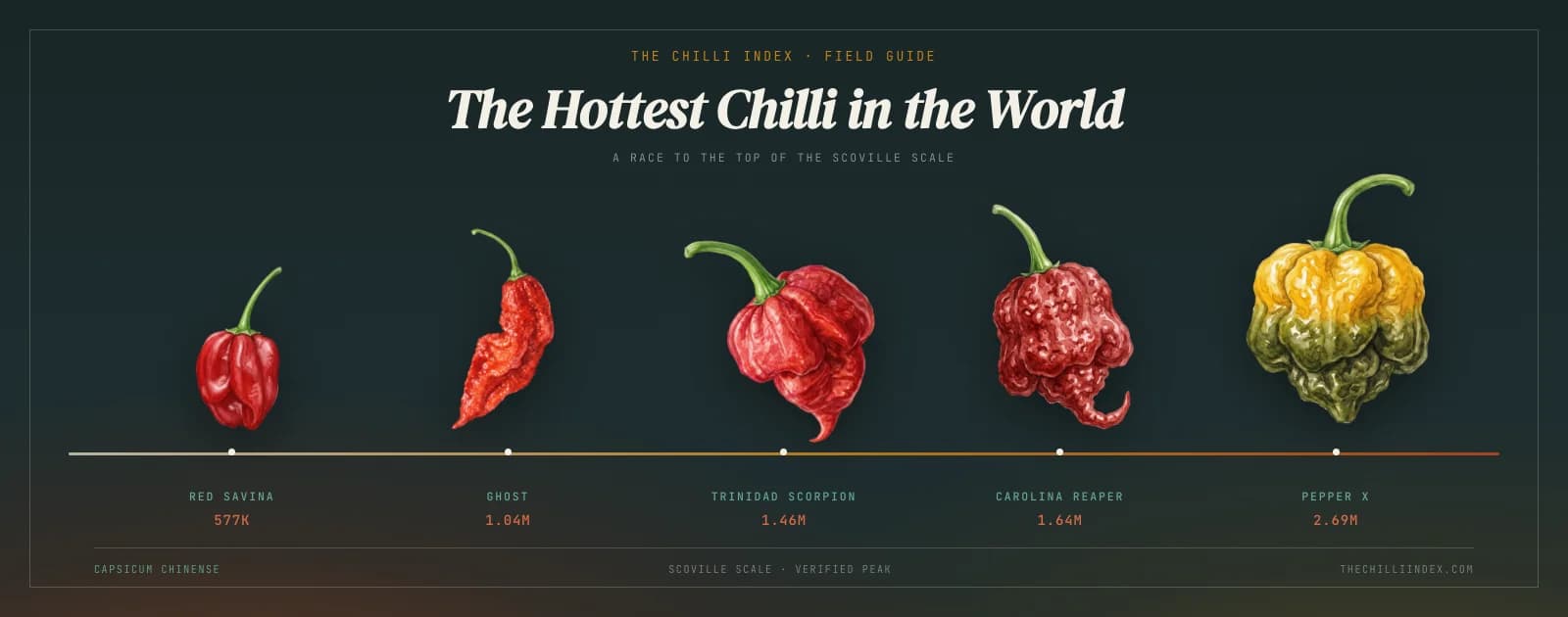
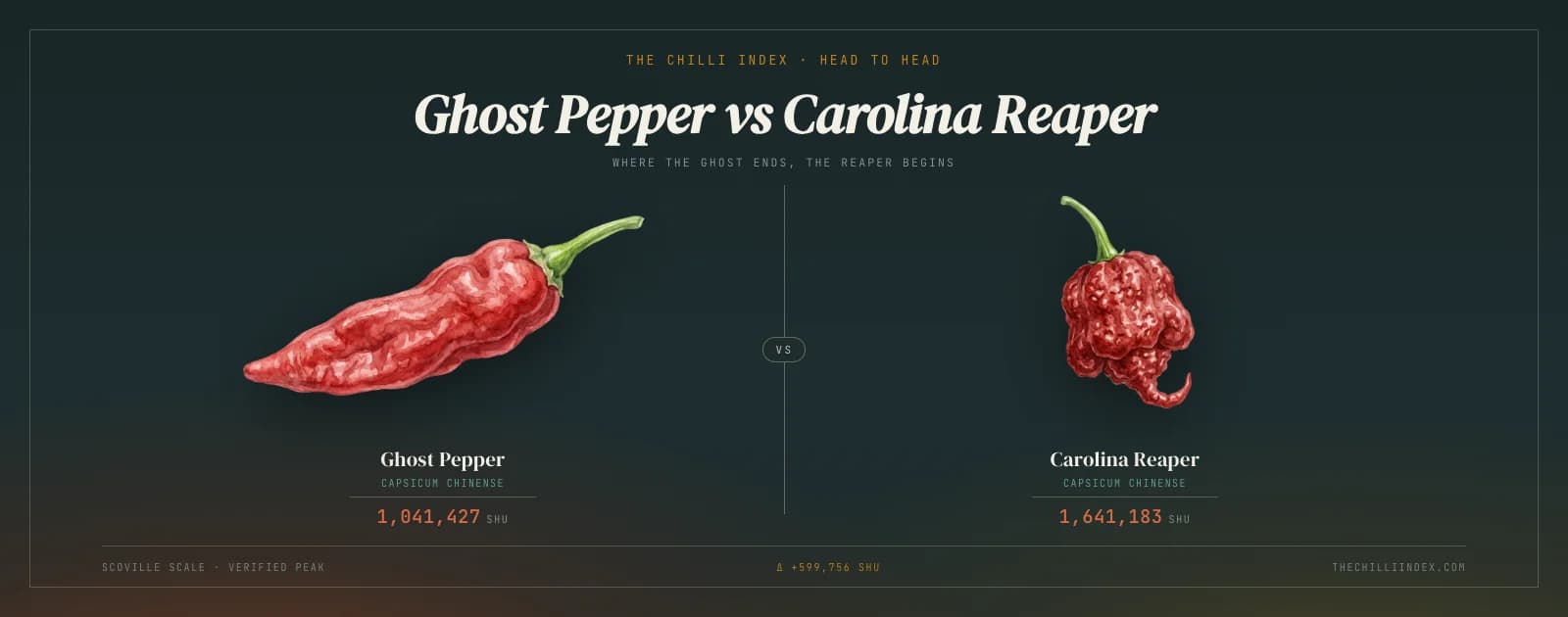
The race for the world's hottest pepper is a modern phenomenon, and it moves fast. The ghost pepper (Bhut Jolokia) became the first chilli scientifically verified past a million SHU in 2007, and the modern superhot era began in earnest. The Carolina Reaper, bred by Ed Currie, took the official Guinness title in 2013 at an average of around 1.64 million SHU. In 2023, Currie broke his own record with Pepper X, certified at an average of roughly 2.69 million SHU - the current title holder.
- 1994Red Savina Habanero577K SHU
Held the title through the 1990s.
- 2007Bhut Jolokia (Ghost Pepper)1.04M SHU
First chilli scientifically verified past one million SHU.
- 2011Trinidad Scorpion Butch T1.46M SHU
The superhot race accelerates.
- 2013Carolina Reaper1.64M SHU
Bred by Ed Currie; held the record for a decade.
- 2023Pepper X2.69M SHU
Currie breaks his own record — the current title holder.
Above the certified records sits a fog of contenders - Apollo (another Currie cross, reportedly over three million), Dragon's Breath, Chocolate Bhutlah - none yet verified by Guinness, and some suspected of being more marketing than measurement. And beyond chillies entirely, the scale keeps climbing: pure capsaicin measures around 16 million SHU, police-grade pepper spray sits in the low millions, and resiniferatoxin - a compound from a Moroccan plant, emphatically not something you eat - registers in the billions. There is, it turns out, almost always something hotter.
For the top of the scale specifically - everything in the index at a million SHU or more, ranked, with the source behind each figure and a note on which were never verified - see the hottest chillies in the world.
Taming the burn
If you overdo it, the single most useful fact is this: capsaicin is oil-soluble, not water-soluble. Reaching for a glass of water is the instinctive move and close to the worst one - all it does is spread the capsaicin around your mouth. Beer is no better.
What works is dairy. Milk, yoghurt and ice cream contain a protein called casein that binds to capsaicin and physically lifts it off your TRPV1 receptors. Fats and oils help for the same reason, and a spoonful of sugar or a mouthful of plain starch - bread, rice - can take the edge off. Mostly, though, it's a waiting game: the receptors reset on their own, and the panic passes.
How we use heat on The Chilli Index
Every variety in the Index carries a heat rating and an SHU range, cross-checked rather than copied from the first figure the internet offers. The five-chilli gauge gives you the shape of it at a glance; the range tells you the honest spread. The ladder above is built from those same records, so it stays current as the database grows.
If this piece has made you curious where your favourite sits - or which varieties you could actually handle - browse the full database by heat and find out. Fair warning about the top end.