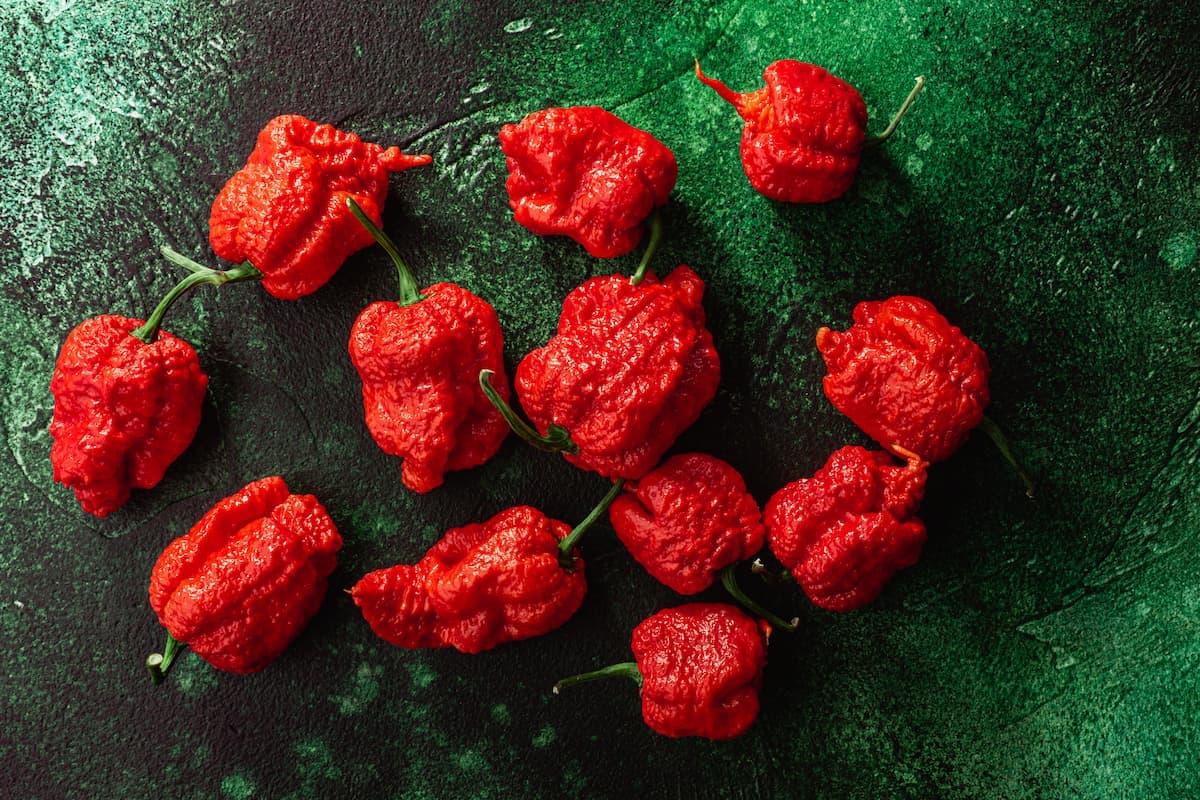
Capsicum chinense
Home of the habanero, Scotch bonnet and nearly every superhot. Several flowers per node, a ring-like constriction below the calyx, and a long season - start early in the UK. Despite the name, it's from the Amazon, not China.
Capsicum chinense is the species behind habaneros, Scotch bonnets and almost every superhot on record. The name is a mistake that stuck. Nikolaus von Jacquin published it in 1776 from plants growing on Martinique, and why he chose chinense was never recorded. The species is South American, from the Amazon basin, and has nothing to do with China.
How to recognise it
Three features together, rather than any one alone:
- Several flowers per node. Annuum usually carries one. Chinense often carries two to five.
- A ring-like constriction below the calyx. Look at the join between stalk and pod for a small pinched collar. It is the best single field character, though it can be faint on an individual plant.
- Greenish-white petals, on a flower that usually hangs downwards.
Pod shape tells you very little. Chinense covers the smooth, bell-shaped Scotch bonnet, the wrinkled and tailed superhots, and plenty in between. Extreme heat is a hint rather than proof, and there are mild chinense varieties.
Growing chinense in the UK
Time is the whole problem. Chinense germinates slowly and unevenly, often taking two to three weeks of steady warmth, and then wants a long season to ripen what it sets. Sow in January or early February rather than March, keep bottom heat under the tray, and give the seedlings as much light as you can manage.
Plants should go outside only once nights are reliably into double figures. A greenhouse, a polytunnel or a sunny wall makes a real difference to whether late pods colour up before autumn shuts the season down.
If a plant is still healthy in October it is worth overwintering. A second-year chinense flowers weeks earlier, and for this species that is often the difference between a crop and a handful of pods.
Compare Capsicum annuum for the quicker, more forgiving species, and C. frutescens, its closest relative and the one it is most often confused with.