Ask which is hotter, a Scotch bonnet or a habanero, and you will get a confident answer from almost anyone who cooks. You will also get a different answer depending on who you ask.
The truthful answer is duller and more useful: on heat alone, there is nothing to choose between them. Both sit in the same band, and the pod you happen to pick up matters far more than the name on the label. What actually separates them is shape, flavour, and about two thousand miles of culinary history.
The heat question, settled
Both peppers are Capsicum chinense, and both land in the same range.
Scoville
350,000 SHU
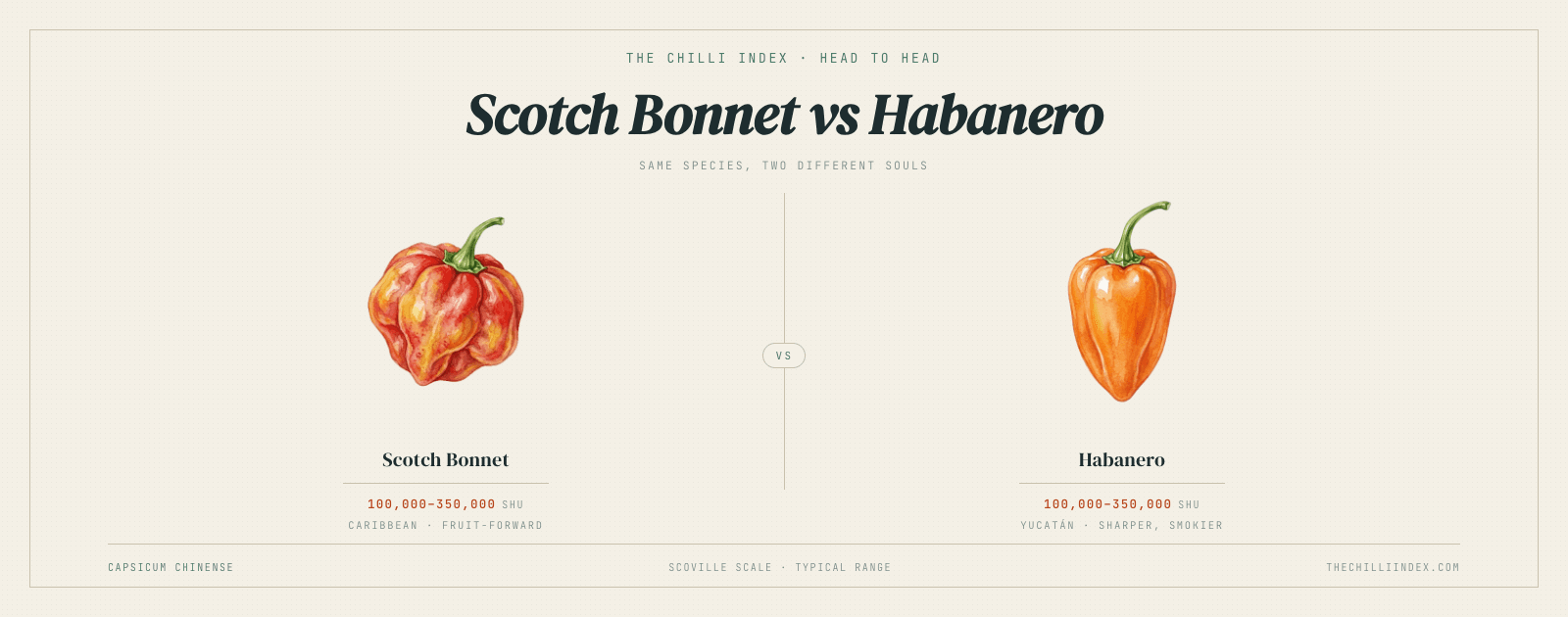
A Scotch bonnet and a habanero from the same shelf will typically fall somewhere between 100,000 and 350,000 Scoville Heat Units. That is a wide band, and it is wide for a reason: heat in an individual pod depends on the plant's water stress, how much sun it got, how ripe it was when picked, and where in the pod you bite. A stressed plant in a hot summer produces noticeably fiercer fruit than the same cultivar grown soft and well watered.
So if a recipe calls for one and you have the other, heat is not the reason to hesitate.
What actually differs: shape
This is the reliable way to tell them apart in a shop.
A Scotch bonnet is squat and crumpled, wider than it is tall, with a distinct lobed dent at the base. The name comes from the resemblance to a tam o' shanter - a flat Scottish bonnet. Pick one up and it sits in your palm like a small crushed lantern.
A habanero is taller than it is wide, more elongated, tapering to a blunt point. Smoother-shouldered, less crumpled, more obviously pod-shaped.
Both ripen through green to orange, red, or in some cultivars chocolate brown and white. Colour tells you about the cultivar, not the species, and it is a poor guide to which is which.
What actually differs: flavour
Here the difference is real, and it is the reason to care.
The Scotch bonnet leans sweet and fruity. There is a tropical note underneath the heat - something close to apricot or overripe mango - and it carries a rounder, slightly heavier body. That sweetness is the reason it holds up in dishes with sugar, allspice and thyme without being flattened by them.
The habanero is sharper and more floral. The aroma reads as citrus and green apple rather than stone fruit, and the finish is cleaner. Where the bonnet lingers, the habanero cuts.
Whether you notice the difference depends heavily on what else is in the dish. In a slow-cooked stew with browned meat and heavy aromatics, the two are close to interchangeable. In a fresh salsa, a raw hot sauce or anything where the pepper is the loudest thing in the bowl, the difference is obvious.
Where each one comes from

C. chinense
Scotch Bonnet
350,000 SHU
The Scotch bonnet is the pepper of the anglophone Caribbean - Jamaica above all, but also Trinidad, Barbados and the Guyanese and Haitian kitchens that share the tradition. It is inseparable from jerk seasoning, from Jamaican pepper sauces, and from the pot of rice and peas that has a whole bonnet dropped in and fished out before serving.

C. chinense
Habanero
350,000 SHU
The habanero's modern home is the Yucatán Peninsula in Mexico, where it is grown at scale and used in the sharp, citrus-forward salsas of the region. Its name means "from Havana", which is a clue that the pepper travelled: C. chinense originates in the Amazon basin, moved through the Caribbean, and was carried into Mexico rather than domesticated there.
That shared ancestry is why they taste like relatives. They are.
Substituting one for the other
The short version: yes, in most cooked dishes, one for one.
The longer version depends on what the pepper is doing.
Swap freely in stews, curries, braises, marinades and anything simmered for more than twenty minutes. The differences soften and the heat is equivalent.
Swap with care in fresh salsas, raw sauces, ceviche and dressings. Here you are tasting the pepper directly. Going habanero-to-bonnet adds sweetness; going bonnet-to-habanero adds a citrus edge and takes some body away.
Do not swap in a dish that is culturally about the pepper. Jerk chicken made with habanero is a good dinner, but it is not jerk chicken. The same applies in reverse to a Yucatán salsa made with bonnets.
Handling either of them
At six figures on the Scoville scale, both deserve respect and neither is dangerous with sensible handling.
Wear gloves if you are processing more than one or two, and if you do not, keep your hands away from your eyes for several hours afterwards - capsaicin is oil-soluble and does not rinse off with water alone. Wash boards and knives with soap and hot water rather than a quick rinse.
Most of the heat sits in the placental tissue, the pale ribs the seeds attach to. Removing that tissue takes a substantial share of the burn out while keeping the fruit flavour, which is the standard trick when you want the character without the intensity. Seeds themselves carry very little capsaicin; they simply sit next to the part that does.
The practical summary
If the question is which is hotter, the answer is neither, and anyone giving you a confident number is talking about one pod rather than one variety.
If the question is which to buy, buy for the dish. Sweet, rounded, Caribbean, jerk, slow-cooked: Scotch bonnet. Sharp, floral, citrus, fresh, Mexican: habanero. If neither is available, take whichever one the shop has and adjust the acid and sugar around it.