Carolina Reaper
Cultivar · HP22B, Smokin' Ed's Carolina Reaper
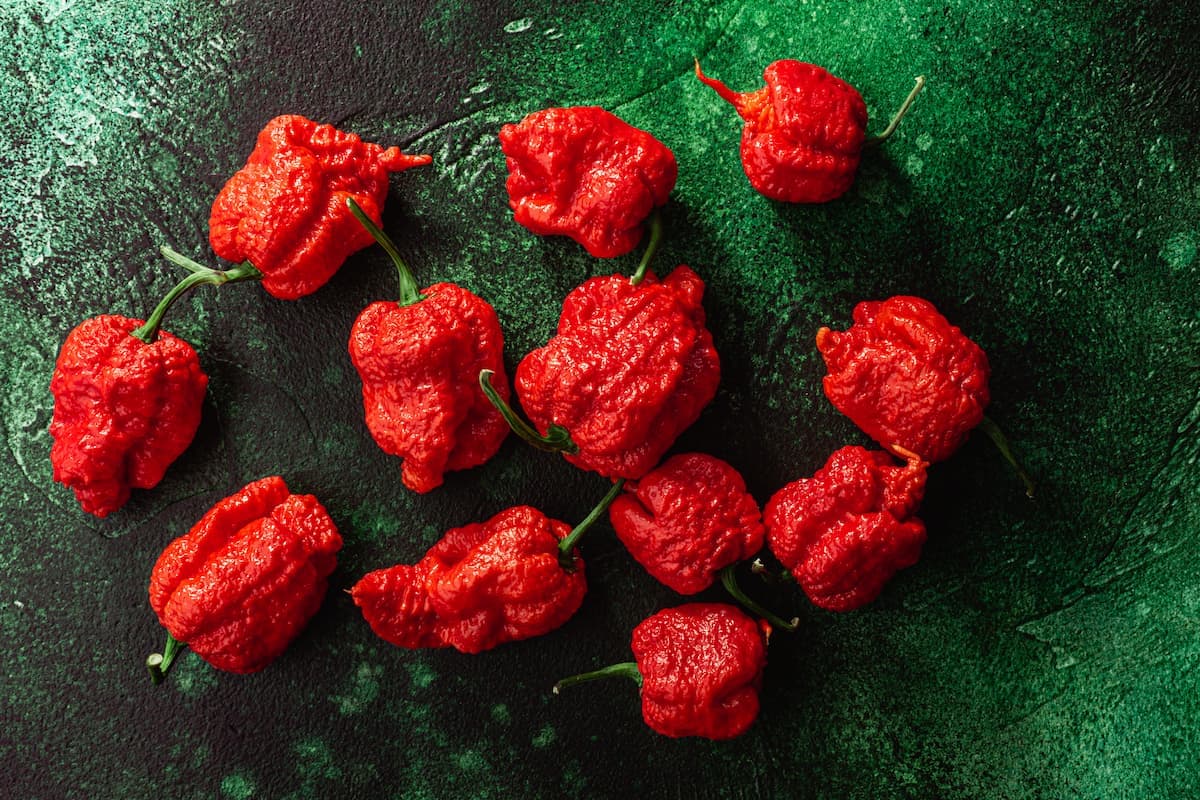
The Carolina Reaper held the Guinness World Record as the world's hottest chilli from 2013 to 2023, averaging 1.64 million SHU with peaks above 2.2 million. Bred by Ed Currie of PuckerButt Pepper Company in South Carolina, this superhot is recognisable for its wrinkled red pods and distinctive scorpion tail. Beneath the punishing heat, the Reaper carries genuine flavour - fruity, sweet, with subtle cinnamon notes that come through if you can taste through the burn.
History & lineage
The Carolina Reaper was officially named the world's hottest chilli by Guinness World Records in November 2013, with an average heat of 1.64 million SHU and individual pods tested above 2.2 million. The cultivar was developed by Ed Currie, founder of the PuckerButt Pepper Company in Fort Mill, South Carolina, who spent over a decade breeding the variety from a cross involving a "La Soufriere pepper from Saint Vincent" and a Naga Morich.
Currie's breeding philosophy was unusual in the superhot world: he wanted heat plus genuine flavour, not just record-breaking SHU figures. The Reaper's sweetness, fruit notes, and cinnamon undertones reflect this approach - it's widely considered the most flavourful of the modern superhots, which is why it has dominated commercial hot sauce production despite no longer holding the heat record.
The Reaper held its Guinness title for ten years - the longest reign of any modern superhot - before being dethroned in October 2023 by Currie's own follow-up cultivar, Pepper X. Where Pepper X seeds remain proprietary to PuckerButt, the Carolina Reaper has been freely available to home growers and seed savers for years, making it the most widely cultivated superhot in private gardens worldwide.
The variety's name was chosen for the curved tail at the bottom of each pod - shaped like a reaper's scythe. The "Carolina" referenced both the state of origin and Currie's sense of regional pride. The first commercial Reaper hot sauces appeared in 2012, ahead of the official Guinness recognition, and the variety has been a fixture of the superhot scene continuously since.
Medical case reports have linked Reaper consumption to two notable conditions: the "thunderclap headache" syndrome (severe brief headaches caused by extreme capsaicin response) and rare cases of esophageal rupture. Both are extreme reactions to extreme consumption - normal culinary use, with proper handling, carries no significant health risk beyond the obvious heat.
Before it had a name it was HP22B, the designation in Ed Currie's own breeding records, and it only became the Carolina Reaper after a radio journalist visited while it was still in development in late 2011. Its parentage is less settled than the record suggests. Currie describes the pollen parent as a Pakistani naga while acknowledging that plenty of people say no such pepper exists; other accounts give an Assamese ghost pepper instead. The seed parent, a La Soufrière habanero from Saint Vincent, is agreed on.
It is a demanding plant, and PuckerButt's own growing guide is candid about it: refrigerate the seed for three days, soak it in black tea before sowing, and expect germination anywhere between one week and six. A mature plant reaches something like four feet across and six feet tall, and can take five months from transplanting to ripe fruit. That is a long season anywhere, and in Britain it means starting under glass in January and accepting that some years it will not finish.
Its fame has had consequences. A crisp product dusted with Carolina Reaper, sold as a one-chip dare, was linked to the death of a fourteen-year-old in the United States in 2023; the medical examiner recorded cardiac arrest following ingestion of a high-capsaicin food, alongside a pre-existing heart condition, and the product was withdrawn. Superhots are not dangerous to most healthy adults in ordinary quantities, but a concentrated dose marketed as a challenge to teenagers is a different proposition, and worth saying plainly on a page about the variety.
Culinary uses
Almost always as an ingredient in something, and almost never on its own. Its commercial life is hot sauce — PuckerButt's own is 92% pepper to 8% vinegar and nothing else — along with powders, extracts and the challenge-food trade. In a kitchen, a fraction of a pod is enough to carry a large pot, and the fruity, faintly sweet chinense character underneath is a real reason to use it rather than a hotter extract. Wear gloves, keep it away from your eyes, and ventilate the room before frying it. Its thin walls dry and grind well, which is the easiest way for a grower to store a glut.
Growing it in the UK
Chinense is the slow one. Seed can take three weeks to germinate and wants steady warmth to do it, so sow in January or February with a heated propagator and expect to ripen the fruit under cover. Germination is given as 14-28 days. 110 days to maturity is a long season for this country. Sow in February at the latest, and keep it under cover from September so the last fruit colours up.
At 90–150 cm it is one of the tall ones — a greenhouse border, a cane in from the start, and room to lean. The record puts the yield at heavy, so start feeding weekly with something high in potassium as soon as the first fruit sets — a plant carrying that much will run out of steam otherwise.
This is superhot territory, and the handling advice is not decorative: wear gloves when cutting it, keep your hands away from your eyes for the rest of the day, and open a window before frying it — capsaicin in hot oil will clear a kitchen. Thin walls and a high drying score mean it dries well — thread the pods on a string somewhere warm and they will keep for a year.
Read from this variety's own record — the figures are in the panel opposite.
Read more about Carolina Reaper
All articles →Pepper X holds the record at 2,693,000 SHU. Almost everything else written on this subject is a claim with no paperwork behind it - so here is which figure came from where.
The Reaper held the world record for a decade and it will grow in a British greenhouse - but the difference between ripe pods and a compost heap is almost entirely about when you sowed.
One grew out of northeast India over centuries; the other was built in South Carolina to break a record. The heat gap is real but overstated - what differs is what they're for.


