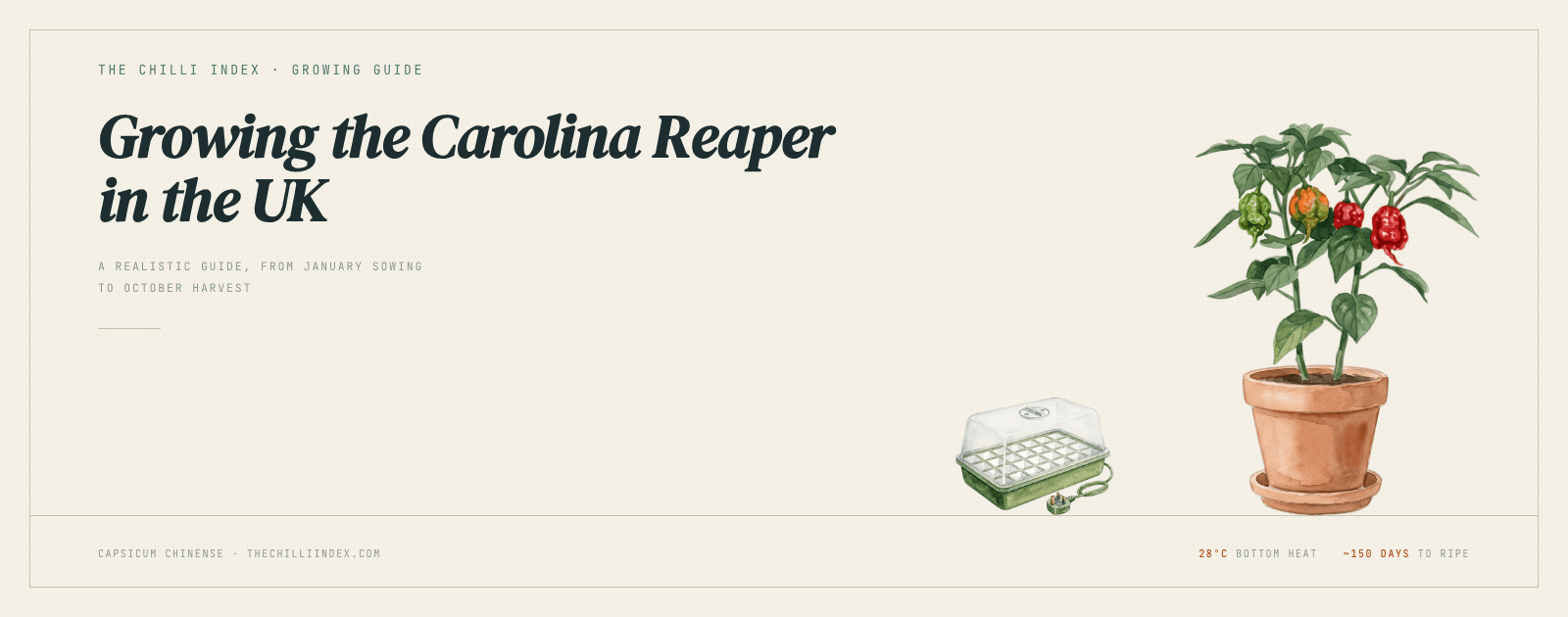
The Carolina Reaper held the Guinness World Record for a decade, and it is still the pepper most people name when asked for the hottest chilli in the world. It is also, slightly improbably, growable in a British greenhouse.
Not easily. But it is a genuine gardening project rather than a fantasy, and the difference between the people who manage it and the people who end up with a plant covered in green pods in October is almost entirely about when they started.
C. chinense
Carolina Reaper
2,200,000 SHU
What it actually is
The Reaper was bred by Ed Currie of the PuckerButt Pepper Company in South Carolina, from a cross of a Pakistani Naga and a Red Habanero. Guinness certified it in 2013 at an average of 1,641,183 SHU, and it held the title until Currie's own Pepper X displaced it in 2023.
Scoville
2,200,000 SHU
You will see two very different numbers quoted for it. The Guinness figure of 1.64 million is an average across many pods. The 2.2 million figure widely quoted by seed sellers is a peak - the hottest individual pod recorded. Both are real; they answer different questions. Expect a typical home-grown pod to land closer to the average, and expect that to be more than sufficient.
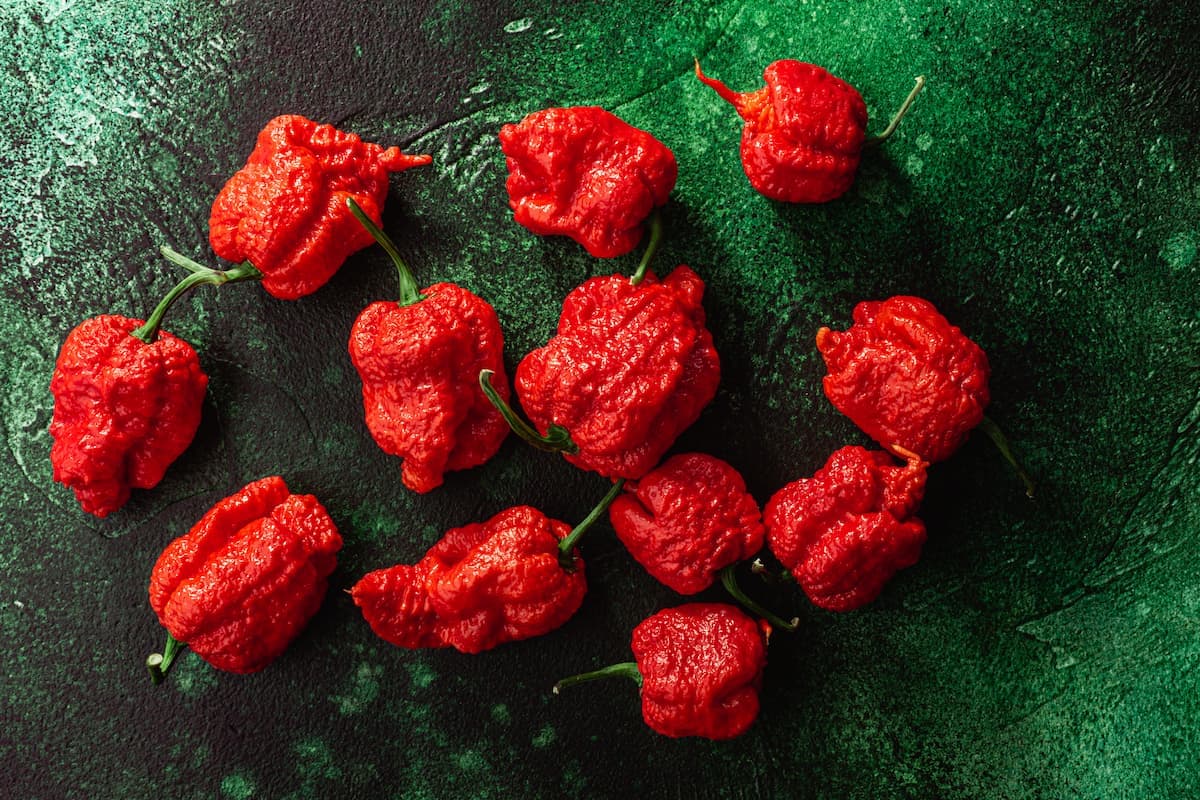
The pods are small, red, deeply wrinkled, and finished with the scorpion-like tail that gives the variety its look. The flavour underneath is genuinely fruity - sweet, almost cherry-like - for the second or so before the heat removes your ability to assess it.
The British problem, stated plainly
The Reaper is Capsicum chinense. It wants around 150 days from transplant to ripe fruit, high consistent warmth, and a long season.
South Carolina provides that. Britain does not.
Everything about growing this variety here is compensation for that gap, and there are only really three levers: start earlier, keep it warmer, and extend the season at the far end.
Sow in January
Not February. January.
Working backwards: ripe pods by late September, roughly 150 days from transplant, several weeks from sowing to a transplantable seedling, and slow erratic germination on top. That puts sowing in the first half of January, and even that leaves little slack.
Reaper seed is notoriously slow and uneven. Three weeks to germinate is unremarkable, and a tray where half the seeds appear at day ten and the rest at day twenty-five is entirely normal.
Bottom heat is not optional. 28°C in a heated propagator, kept consistently, is the single highest-value thing you can do for this variety. Germination rates fall off sharply below 25°C and approach zero on a cool windowsill.
On a January windowsill the compost sits at 10–15°C — well below what seeds need. A heat mat or heated propagator is the best few pounds you'll spend all season.
Sow more than you need. A 50% germination rate is a reasonable expectation, and thinning down from six healthy seedlings is a better position than nursing one weak survivor.
Light, then patience
Reaper seedlings grow slowly. This is normal and not a sign that anything is wrong.
What is a sign that something is wrong is stretching - a long pale stem reaching for the window. A January or February seedling on a British windowsill is short of light by a wide margin, and a grow light on a 14 to 16 hour timer pays for itself in a single season.
Pot on gradually: module, then 9cm, then a 5 to 10 litre final pot. Chinense plants build a substantial root system and will produce far better in a large pot than a small one.
Under glass, always
Be blunt about this: outdoors in the open, in most of Britain, in most years, a Carolina Reaper will not ripen.
It will grow. It will flower. It will set green pods in August and they will still be green when the first frost arrives.
A greenhouse, polytunnel or conservatory changes the arithmetic completely - not just the daytime warmth but the overnight minimum, which is what actually governs whether a chinense plant keeps developing fruit. A sunny south-facing conservatory is arguably the best Reaper environment in the country.
Feeding and the heat trade-off
Move to a high-potassium feed - ordinary tomato feed is fine - as soon as flowering begins, and keep feeding right through to late summer. Nitrogen early for the frame; potassium later for the fruit.
Water consistently. The most common way to kill a potted chinense in Britain is not drought but cold wet compost in a dull July.
There is a genuine trade-off worth knowing about. Mild water stress increases capsaicin: a plant kept slightly dry produces hotter pods. It also produces fewer and smaller ones. Given that a well-grown Reaper is already past most people's tolerance, growing it soft and productive is usually the better call.
Ripening, and the September decision
The pods take a long time to colour, and the last stage is where the flavour arrives.
By mid-September you will know which way the season has gone. If pods are colouring, keep going and pick as they finish. If the plant is covered in green pods and the nights are dropping, get it indoors under any glass you have. October ripening in a conservatory is common and perfectly good.
Green Reaper pods are edible and still very hot, but they lack the fruit character that makes the variety interesting.
Handling it
At this heat level, handling matters more than it does for anything in a supermarket.
Wear gloves. Not as a precaution - as a requirement. Capsaicin at Reaper concentrations transfers readily to skin and stays there through several ordinary hand washes, and the delayed transfer to eyes, face or anywhere else hours later is the classic and thoroughly unpleasant mistake.
Ventilate when cooking with it. Frying Reaper in a closed kitchen produces a genuinely irritating aerosol.
Keep the crop clearly labelled and away from anyone who might treat a small red pod as an ordinary chilli.
Is it worth it?
As a crop, honestly, no. One plant produces more heat than most households use in a year, and you can buy a Reaper sauce for the price of a bag of compost.
As a growing project, yes - and it is worth being clear about which of those you are doing. Getting a chinense from a January windowsill to a ripe red pod in a British October is a real horticultural achievement, and it teaches you more about germination temperature, light and season length than any easy variety will.
If you want the achievement without quite the same difficulty, the Dorset Naga is a superhot bred specifically for British conditions, and it is a far more cooperative plant.
C. chinense
Dorset Naga
1,600,000 SHU