On April Fools' Day 2006, a small seed company in west Dorset told their local paper they had grown a very hot chilli. Nobody believed them - and within a day the story was on news sites around the world.
The Dorset Naga is the most significant chilli ever bred in Britain, and its origin story is far less glamorous than the headlines suggested. It starts in an Asian grocery in Bournemouth.
Ten plants from a corner shop
Michael and Joy Michaud run Sea Spring Seeds near Bridport. In the late 1990s they bought some naga morich - a landrace chilli from Bangladesh - and grew ten plants from it.

C. chinense
Naga Morich
1,500,000 SHU
A landrace is not a variety in the formal sense. It is a population: broadly similar plants carrying real genetic variation, shaped over generations by the growers who kept saving seed from whatever did best. Grow ten plants of a landrace and you get ten slightly different chillies.
The Michauds spent roughly a decade selecting from that population - keeping the plants that performed, discarding the rest, and doing it again - until they had something distinct, uniform and stable enough to be called a variety. Crucially, they were also selecting for plants that would actually crop in a British climate rather than a Bangladeshi one.
That is the unglamorous middle of the story, and it is the part that matters. The record came later and by accident.
The number
In 2005 they picked one ripe fruit from each plant in a crop of around 240, dried the harvest, and sent it to the United States for analysis.
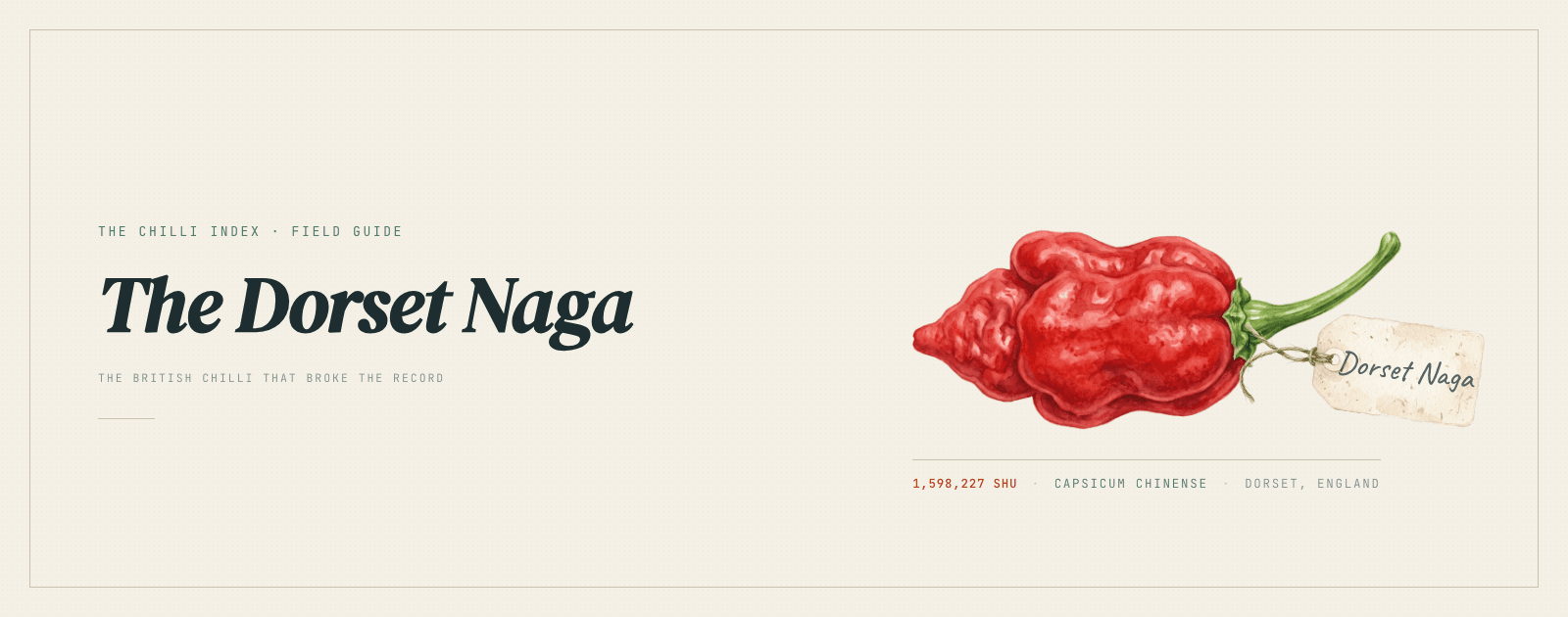
One sample came back at 1,598,227 Scoville Heat Units.
Scoville
1,598,227 SHU
At the time, that was the highest figure ever published for a chilli - comfortably above the Red Savina habanero that then held the Guinness title. The Michauds mentioned it to the Bridport News in March 2006. The story went worldwide on the 31st of March, which several outlets noted was suspiciously close to April Fools' Day.
C. chinense
Dorset Naga
1,600,000 SHU
Why it never held the world record
This is the question people ask, and the answer is procedural rather than dramatic.
Guinness World Records requires a specific submission and verification process. The Michauds did not pursue it. What they did pursue was plant variety rights: they submitted Dorset Naga to the EU Community Plant Variety Office, which ran three years of independent trials, and in 2009 recognised it as a new and distinct variety with Plant Breeders' Rights attached.
That is a different kind of certificate, and arguably the more meaningful one. A Guinness record says a pod tested hot on a particular day. Plant Breeders' Rights say an independent authority grew your variety for three years and confirmed it is genuinely new, genuinely uniform, and genuinely stable.
Meanwhile the record itself moved on. The Bhut Jolokia was certified in 2007, and the escalation that produced the Carolina Reaper and eventually Pepper X was under way.
What it is actually like
The Dorset Naga is a Capsicum chinense, and it behaves like one: a floral, fruity aroma that arrives before the heat and then gets comprehensively buried by it.
The pods are small, wrinkled, and ripen from green through to a bright red or orange. The heat is a slow build rather than an immediate hit - twenty or thirty seconds of thinking it might be manageable, followed by a considerable reassessment.
In cooking it is a seasoning rather than an ingredient. A single pod will carry a large pot of curry. It is well suited to fermented sauces, where the fruitiness survives and integrates, and to Bangladeshi-style pickles and chutneys that reflect its ancestry.
Growing it in Britain
This is the point of the variety, and the reason it exists.
Dorset Naga was selected in Dorset, for Dorset conditions. It is still a chinense, so it needs a long season and warmth - but it was bred by people trying to make a superhot crop reliably in a British summer, and that shows.
Expect to grow it under cover. A greenhouse, polytunnel or conservatory will ripen a good crop in most of England; outdoors in the open it will grow happily enough but often runs out of summer before the pods colour up. Plants reach 60 to 90cm and benefit from support once they are carrying fruit.
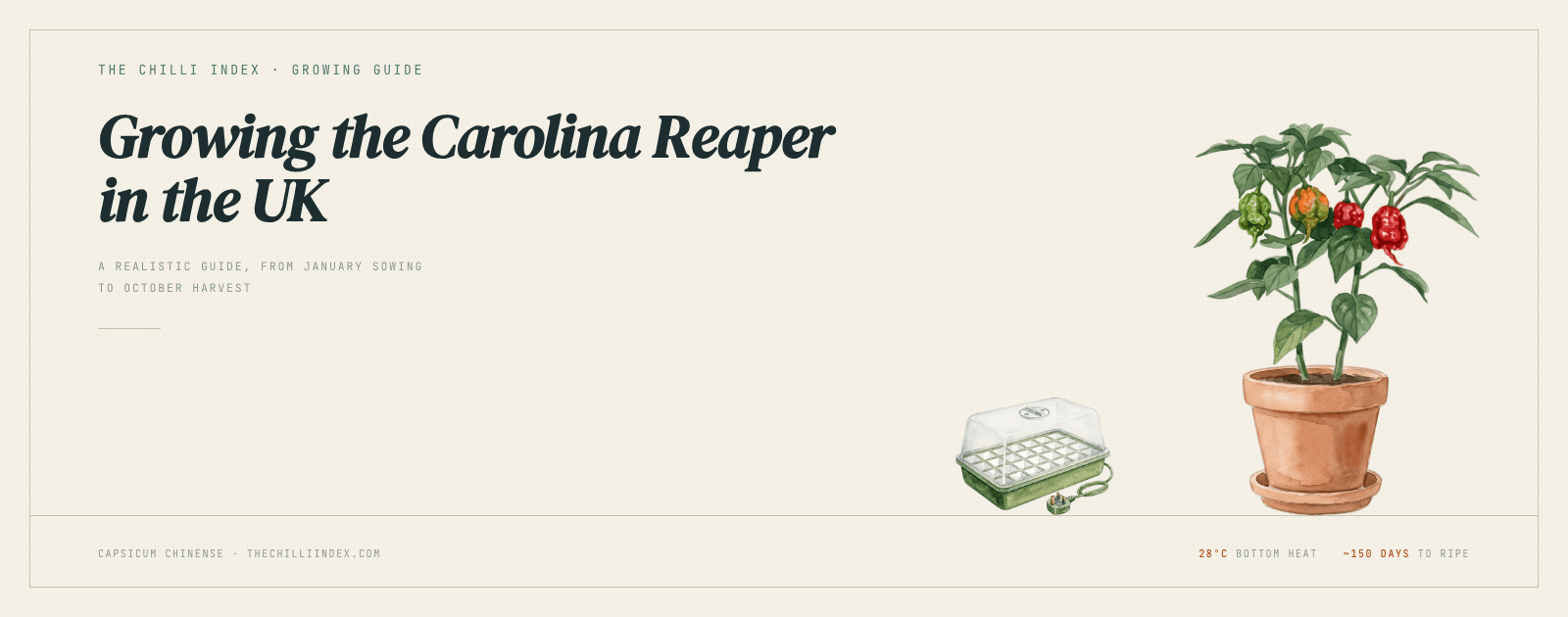
Germination is the stage where most people lose. Chinense seeds want consistent bottom heat and patience, and a windowsill that drops to 15°C overnight will simply not do it.
Why it still matters
Britain is not a chilli-growing country. We have no landrace tradition, no significant commercial capsicum industry, and a climate that makes the whole exercise marginal.
And yet the most serious piece of chilli breeding of the 2000s came out of a smallholding in west Dorset, from seed bought in a corner shop, developed by two people with the patience to select for ten years before telling anyone.
Sea Spring still sell the seed and still grow the crop. That is the more impressive record.