Growing chillies in Britain is a scheduling problem more than a horticultural one.
The plants are not difficult. They want warmth, light and a long season, and they will forgive a great deal of clumsiness in exchange. What they will not forgive is being started in April. A chilli sown in April in Manchester is a chilli that produces its first green pod in late September and gets frosted before any of it ripens.
Everything below is about getting the timing right. Do that and most varieties are straightforward.
Darker = peak. Superhots (C. chinense) can be sown as early as December; milder annuums in January–February.
January to February: sow
This feels absurdly early. It is not.
Superhots - anything in the Capsicum chinense group, which covers habaneros, Scotch bonnets, ghost peppers and the Naga family - need somewhere between 120 and 180 days from sowing to a ripe pod. Count backwards from a British September and you land in January.
The single biggest determinant of success at this stage is bottom heat.
On a January windowsill the compost sits at 10–15°C — well below what seeds need. A heat mat or heated propagator is the best few pounds you'll spend all season.
Chilli seed wants 26 to 28°C to germinate reliably. A warm windowsill is not this. A windowsill that reaches 22°C in the afternoon and falls to 14°C overnight will germinate a handful of your annuums after four weeks and none of your chinense at all. A heated propagator costs less than the seed you will otherwise waste.
Sow into small cells or pots of moist seed compost, cover the seed by about its own depth, and keep the compost damp rather than wet. Germination takes anywhere from seven days for an easy annuum to three weeks or more for a stubborn chinense. Do not throw the tray away at day fourteen - the naga family in particular is notorious for the slow, straggling germination that makes people give up a week early.
March to April: light, pot on, and resist
Germinated seedlings need light immediately, and this is where the second wave of failures happens.
- 1Sown5mm deep, on heat
- 2Germinates1–3 wks (superhots 4–5)
- 3Seed leavescotyledons open
- 4True leaves2nd pair — pot on now
- 5Potted on7cm → 9cm pot
- 6Growing onfinal 20–23cm pot
Always handle a seedling by its leaves, never the stem — a bruised stem can kill the plant.
A seedling on a north-facing windowsill in March gets nothing like enough light. It responds by stretching - a long pale stem, widely spaced leaves, the whole plant reaching for a window. That stretch is permanent, and a stretched seedling never really recovers into a strong plant.
The fixes, in order of cost: the brightest south-facing windowsill you have, turned daily so it grows evenly; a simple LED grow light on a timer for 14 to 16 hours; a heated greenhouse if you have one.
Pot on when roots show at the drainage holes - typically from a module into a 9cm pot, and later into the plant's final home. Do it gradually. A small plant dropped into a large pot of cold wet compost sulks and often rots.
May: harden off and plant out
Hardening off means acclimatising a plant grown in stable indoor conditions to the reality of wind, direct sun and temperature swings. Skip it and the leaves scorch or the plant stalls for a fortnight.
Do it over ten days to two weeks. Start with an hour outside in a sheltered spot, build up, and bring plants in overnight until the nights are reliably above 10°C.
Then decide where they live for the season:
- Greenhouse or polytunnel - the best option in Britain by a wide margin, and effectively required for superhots north of the Midlands.
- A sunny sheltered patio - works well for annuums and compact varieties in pots. A wall that holds heat overnight is worth a great deal.
- Open ground outdoors - viable in the south for quick annuums in a good summer. Optimistic elsewhere.
- A bright windowsill - genuinely fine for compact varieties. Apache and Basket of Fire were bred for exactly this.
C. annuum
Apache
80,000 SHU
June to July: feed, water, support
Once the first flowers appear, the plant's needs change.
No feed
—
Seed compost has enough until the first true leaves.
Balanced / high-nitrogen
weekly, half strength
Nitrogen builds leaf and stem — a strong plant to carry fruit.
High-potassium (tomato feed)
weekly, full strength
Switch at first flower — potassium drives flowering and ripening.
Switch from a general feed to a high-potassium one - tomato feed is the standard answer and works perfectly well. Nitrogen grows leaves; potassium grows fruit. Keep feeding through to late summer.
Water consistently rather than heavily. Chillies dislike sitting in cold wet compost, and the classic pot-grown failure is drowning rather than drought. Let the surface dry slightly between waterings, then water properly.
Support anything tall or heavily laden. A plant carrying thirty pods in a pot is top-heavy, and a snapped main stem in August ends the season.
Pollination usually looks after itself outdoors. Under glass, with no wind and few insects, give flowering plants a gentle shake every few days or run a finger over the open flowers.
August to September: ripen
Green pods are edible. Ripe pods are better, and most of the flavour and heat arrives in the final stage of colouring.
The temptation is to pick early. Resist it where you can: a pod left to colour fully has substantially more character. The exception is late in the season, when ripening is slowing anyway and picking the ripe ones encourages the plant to keep going.
If September is cooling and you still have a plant covered in green pods, bring it indoors. A plant in a conservatory or on a bright windowsill will often carry on ripening well into October.
October onwards: harvest, then decide
Pick everything before the first frost.
A glut is normal and easily handled. Chillies dry well - whole on a string for thin-walled varieties, sliced for thick-walled ones - and freeze even more easily, whole in a bag, with almost no loss for anything destined to be cooked.
Then you have a choice. Most people compost the plant. The alternative is overwintering: cut the plant back hard, keep it somewhere frost-free and barely watered through the winter, and start it into growth again in spring. An overwintered plant fruits earlier and heavier in its second year, and it neatly sidesteps the whole January sowing problem.
It does not always work. Chillies are perennial in their native range but they are living well outside it here, and losses over winter are common. It is worth trying on your best plant rather than all of them.
The compressed version
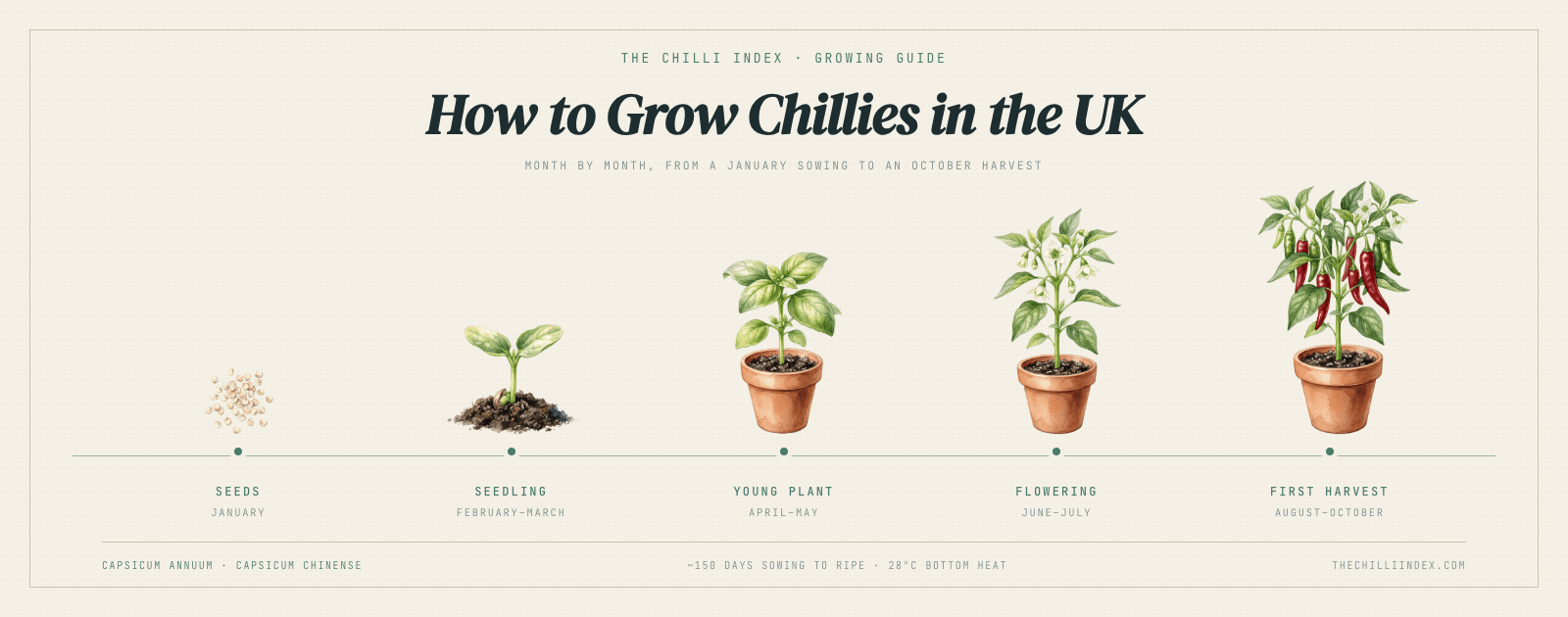
- January: sow chinense (superhots). Bottom heat at 26-28°C, not a windowsill.
- February to March: sow annuum. Get seedlings under strong light immediately.
- April: pot on. Do not put anything outside.
- May: harden off over two weeks, then plant out after your local last frost.
- June: switch to high-potassium feed once flowering starts.
- July to August: water consistently, support the plants, help pollination under glass.
- September: let pods colour; bring plants in as it cools.
- October: harvest everything before frost. Dry, freeze, or overwinter your best plant.
The plants are not the hard part. The calendar is.