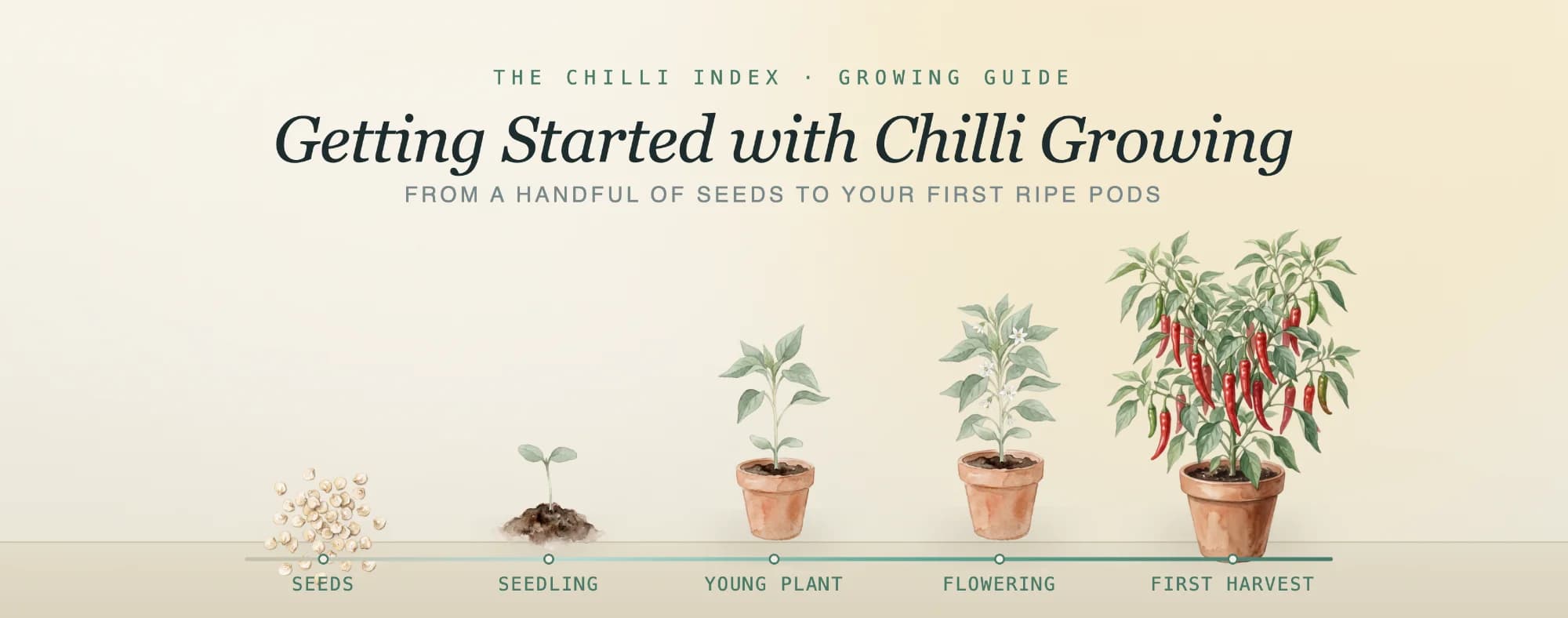
On paper, growing chillies in Britain looks like a mistake. They're tropical plants, bred over thousands of years in some of the hottest places on earth, and we are offering them a climate best described as "damp". And yet thousands of us grow them every year - on windowsills, in greenhouses, in polytunnels held together with hope and gaffer tape - and get cracking harvests doing it.
The secret isn't a greenhouse or a knack you either have or don't. It's understanding what a chilli plant actually wants, and then quietly working around the fact that the UK can't provide it naturally. Do that and the rest is straightforward. This guide takes you from a packet of seeds to a plant dripping with fruit.
Why bother growing your own
Two reasons, mainly. The first is choice: a supermarket offers you maybe two chillies, whereas growing your own opens up hundreds of varieties - fruity, smoky, floral, and hot in ways you can't buy. The second is that home-grown simply taste better, picked ripe and used fresh. Add the quiet satisfaction of raising a tropical plant through a British winter, and the fact that a single plant can out-produce anything you'd reasonably buy, and it's an easy sell.
One thing to be clear about up front: this is a long game. Chillies are slow, and an early start is everything. Get that right and the rest forgives a lot of mistakes.
The British problem, and how to beat it
Chillies want three things Britain is short on: heat, light, and a long growing season. Our frost-free window runs from roughly late May to early autumn, and even our summer nights get cool enough to sulk a plant that would rather be in Trinidad.
So the entire strategy comes down to this: start early, indoors, with artificial warmth; chase every scrap of light; and grow under cover. A greenhouse, polytunnel, conservatory or even a bright windowsill will all beat trusting the open garden. Milder varieties will ripen outdoors in a sheltered, sunny southern spot, but anything hot really wants protection. Get those principles right and you're most of the way there.
Choosing what to grow
Nearly every chilli belongs to one of five species, and knowing which is which tells you a lot about how easy it'll be.
- Capsicum annuum - by far the most common, and the beginner's friend. Jalapeño, cayenne, padrón, most of the "everyday" chillies. Faster, more forgiving, happy on a windowsill.
- Capsicum chinense - the superhots: habanero, Scotch bonnet, ghost, Carolina Reaper. Gloriously fruity and ferocious, but slow to germinate and greedy for a long, warm season. The most demanding to grow in the UK.
- Capsicum baccatum - the South American ají types (Ají Amarillo, Lemon Drop). Big plants, distinctive fruity flavour, well worth a go once you've found your feet.
- Capsicum frutescens - Tabasco and bird's-eye types. Small, upright, and generous with fruit.
- Capsicum pubescens - the rocoto/manzano oddballs, with black seeds and unusual cold tolerance. Hard to find, fun to grow.
Match the plant to your patience and your setup. New to it, with a windowsill? Start with an annuum - a jalapeño or cayenne will reward you fast. Got a greenhouse and the patience of a saint? A chinense superhot is your prize.
The forgiving starting point — fast, reliable, and happy in a UK summer. Start here.
When and how to sow
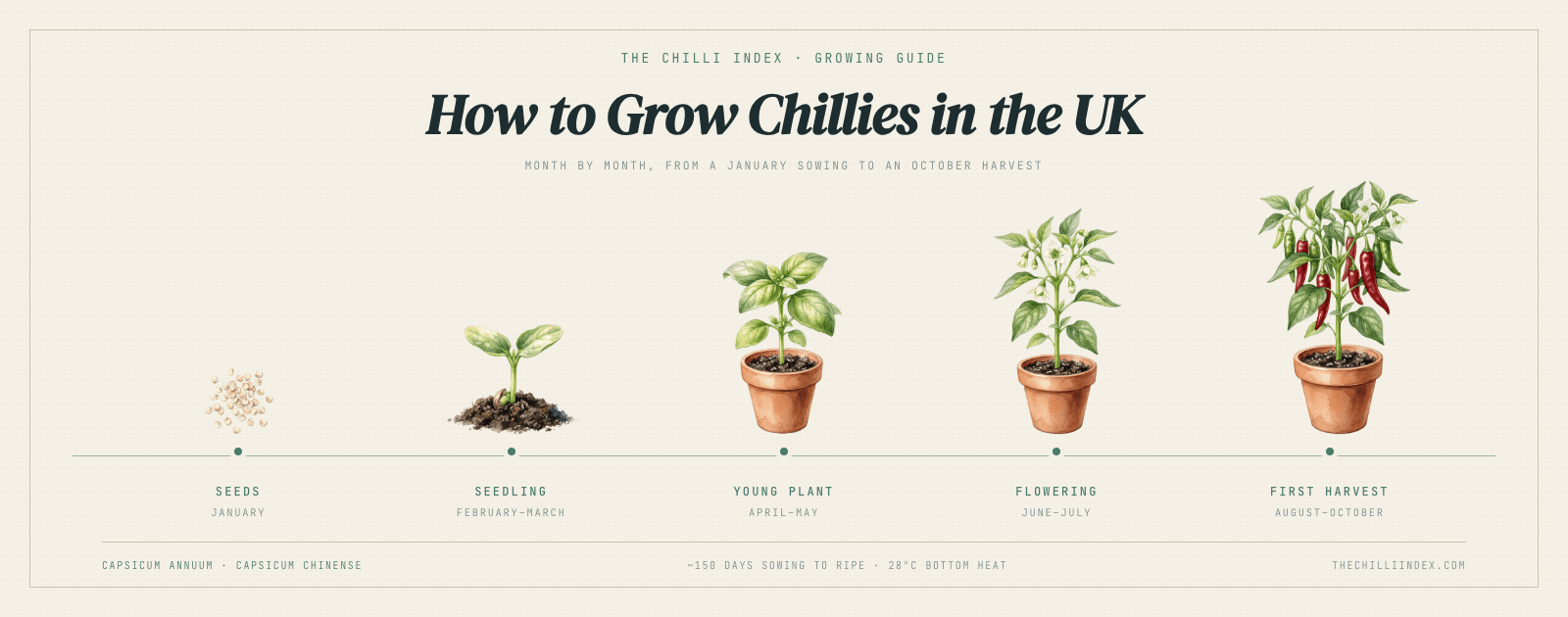
The single biggest beginner mistake is sowing too late. Plenty of people start their chillies in March or April alongside the tomatoes - and then wonder why they're left with a plant full of green fruit that never ripens before the cold shuts everything down.
Chillies need a long run-up. Sow in January or February; superhots can go as early as December. The hotter the variety, the longer it needs, so give it the head start.
Darker = peak. Superhots (C. chinense) can be sown as early as December; milder annuums in January–February.
Then there's warmth. Chilli seeds germinate best at 25-30°C, and this is the part people skip at their peril. On a January windowsill the compost sits at 10-15°C - well below what they need - and germination rates collapse below 50%, dragging out to four to six weeks if it happens at all. A heated propagator or a simple heat mat (around fifteen to twenty pounds) is the best money you'll spend all season. Treat it as essential kit, not a luxury.
On a January windowsill the compost sits at 10–15°C — well below what seeds need. A heat mat or heated propagator is the best few pounds you'll spend all season.
The mechanics are simple. Use a fine, free-draining seed compost, sow about 5mm deep, and cover lightly - a dusting of vermiculite is ideal. Water from the surface with a spray bottle rather than a can, so you don't chill or disturb the seed, and keep the compost evenly moist but never soggy. Cover to hold humidity, keep it on the heat, and label everything - germination time varies wildly between varieties. Most come up in one to three weeks; superhots can take four to five. The moment green appears, get the seedlings into the light.
Looking after seedlings
Light is now the priority. Seedlings starved of it stretch towards the window and become "leggy" - pale, floppy, and weak. A south-facing sill or a grow light will keep them stocky; turn them regularly so they don't lean. If they do get leggy, all's not lost - chillies, like tomatoes, will root from the buried stem, so you can plant them a little deeper when you pot on.
- 1Sown5mm deep, on heat
- 2Germinates1–3 wks (superhots 4–5)
- 3Seed leavescotyledons open
- 4True leaves2nd pair — pot on now
- 5Potted on7cm → 9cm pot
- 6Growing onfinal 20–23cm pot
Always handle a seedling by its leaves, never the stem — a bruised stem can kill the plant.
Pot on once the roots fill the pot and the first true leaves (the second pair) are established, moving up gently - a 7cm pot, then a 9cm. Always handle a seedling by its leaves, never the stem: a bruised stem can kill the plant, but it can spare a leaf. Keep them warm, evenly watered and well ventilated as they grow.
Growing on
As plants get bigger, move them into their final homes - pots of around 20-23cm (3-5 litres). Timing depends on your setup: late April in a heated greenhouse, mid-May in an unheated one, and late May or early June if they're going outside, but only after hardening off - a week or two of gradually increasing time outdoors so the shock of real weather doesn't check them. Wait until nights are reliably above 12°C.
A few habits make the difference between a healthy plant and a productive one:
- Pinch out the growing tip when the plant reaches 15-20cm to encourage a bushier shape and more fruiting points.
- Water consistently - evenly moist, never waterlogged, ideally in the morning. A slight dry spell later in the season can actually push the heat up.
- Feed for fruit, not leaves. Start with a balanced feed, then switch to a high-potassium feed (tomato feed such as Tomorite) once the first flowers and fruit set. Too much nitrogen gives you a lush green bush and almost no chillies - a classic and disheartening mistake.
No feed
—
Seed compost has enough until the first true leaves.
Balanced / high-nitrogen
weekly, half strength
Nitrogen builds leaf and stem — a strong plant to carry fruit.
High-potassium (tomato feed)
weekly, full strength
Switch at first flower — potassium drives flowering and ripening.
Pollination
Chillies are self-fertile, so a single plant can set fruit on its own. Outdoors, wind and insects do the work. Indoors and under cover, there's neither - so you become the bee. Gently shake the plant, or dab inside each flower with a soft brush or a cotton bud, every day or two while it's flowering.
If flowers drop without setting, don't panic - it's usually temperature (too hot, above ~32°C, or too cold, below ~15°C), erratic watering, or too much nitrogen. Fix the cause and the next flush generally sets fine.
When things go wrong
Even a well-run plant hits problems, especially under cover. Most are easily read once you know the signs.
- Aphids (greenfly/blackfly) - clusters on new growth and under leaves. Squash, rinse off, or use a soft-soap spray; ladybirds help under glass.
- Whitefly - tiny white flies that rise in a cloud when disturbed. Sticky traps and good airflow.
- Red spider mite - thrives in hot, dry air, leaving fine webbing and speckled leaves. Mist regularly to deter it.
- Leggy seedlings - not enough light. Move closer to the window or add a grow light.
- Flowers but no fruit - temperature, pollination or excess nitrogen. See above.
- Curling leaves - often aphids, sometimes heat or watering stress. Check the undersides first.
- Blossom end rot - a sunken dark patch at the base of the fruit, caused by irregular watering disrupting calcium uptake. Water more consistently.
- Yellowing leaves - usually overwatering or hunger; check both before acting.
Ripening and harvest
Most chillies can be picked green or left to ripen to red, orange, yellow or purple - and riper generally means hotter and sweeter. Pick regularly, whatever the colour, because a plant that's carrying ripe fruit slows down on making more. As the season ends and temperatures drop, bring plants under cover or harvest everything; stubborn green pods will often finish ripening on a warm windowsill. If you're lucky enough to be overwhelmed, chillies dry, freeze and turn into sauce beautifully.
Keeping plants for next year
Chillies are perennials pretending to be annuals - in the right conditions they'll live for years, and an overwintered plant gives you a huge head start and a bigger crop the following season. In autumn, cut the plant back hard, reduce watering to the occasional trickle, and keep it somewhere frost-free and bright - ideally above 10°C, warmer for the chinense superhots. It'll look thoroughly miserable all winter. Trust the process; it'll wake up in spring.
Where to go next
The best first decision you can make is choosing a variety that suits your setup and your nerve. Browse the database by species and heat to find yours, and once you've sown it, use the tracker to log what you did and when - because the fastest way to get good at this is to keep notes on what actually worked in your conditions, not someone else's.
Start early, keep them warm, chase the light. The rest is patience.